
"I don't want AI touching my client data."
Where your data goes when a workflow uses AI
When I build an automation, we draw a map of every service that touches your data. Here is what the map usually has on it — and the difference between training and retention.
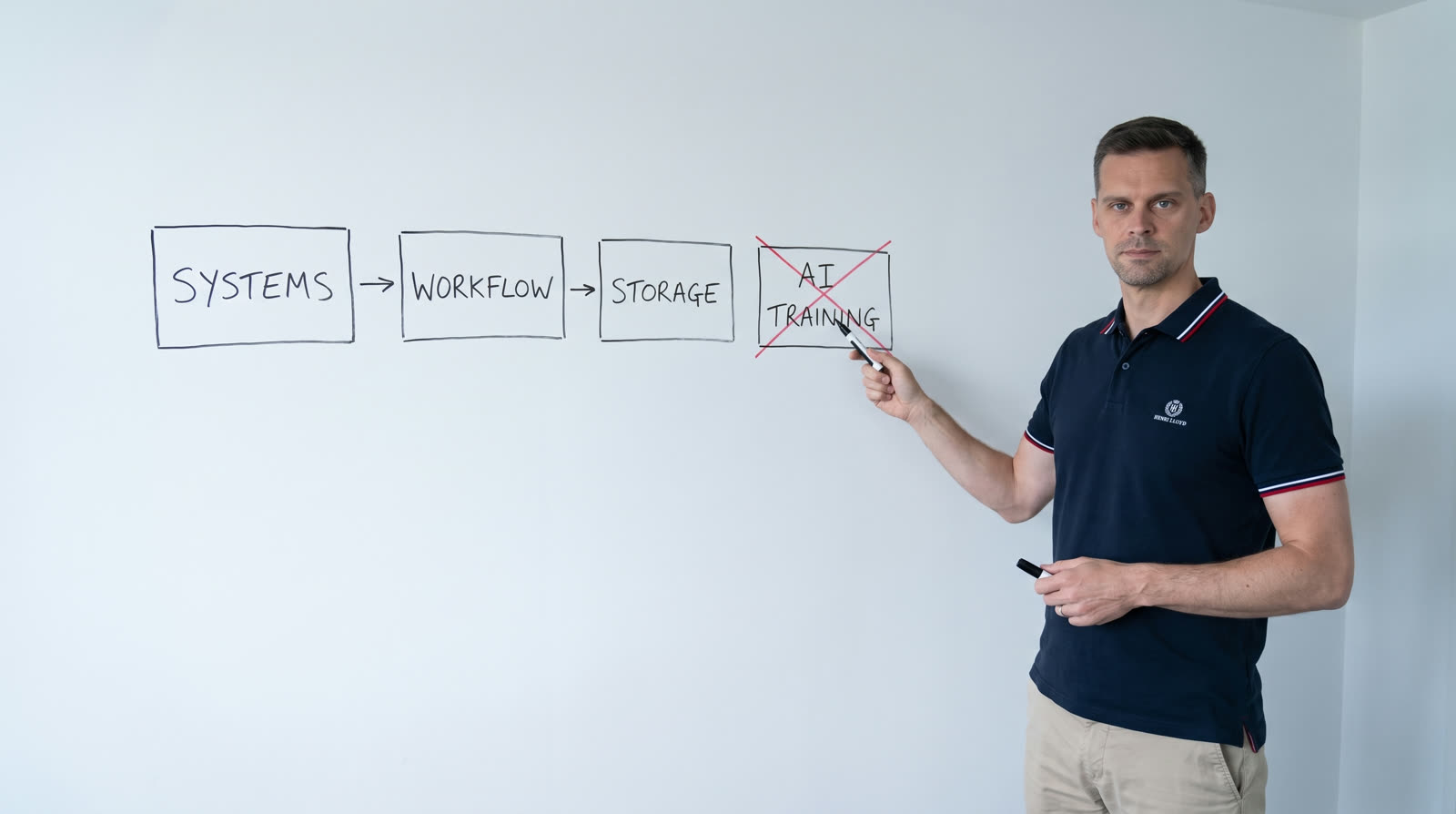
"I don't want AI touching my client data" is one of the most reasonable objections I hear. The word "AI" has become shorthand for a loss of control — the sense that connecting anything to it means your data disappears into a black box you cannot audit.
Here is the honest map.
The data map
When I build an automation for you, we draw a map of every service that touches your data. The map has at least three destinations. Usually four. Sometimes more. Never fewer.
Place one: your existing systems. The Google Sheets, Stripe, Gmail, QuickBooks or Xero you already use. None of that moves. It stays where it already lives.
Place two: the workflow tool. n8n, Zapier, Make, or a small custom script. It runs the steps. Its execution history and logs may retain data from those runs. The retention setting is a specific check we do during scoping.
Place three: your storage. If your workflow needs to remember something — a job status, an approval token, a version number — it writes it to a small database on your account, in your region, under your control. Not mine.
Place four: the AI provider, if the workflow uses one. When my workflows call Claude or GPT, the API receives whatever text the step feeds it. This is a real destination and belongs on the map alongside the others.
Training is not the same as retention
The line most people worry about is "will an AI vendor train its next model on my data?" That is one question. There is a second, separate question: "how long does the vendor keep my data for other purposes, like abuse monitoring?" Both need answers.
For the AI calls I write, the training-opt-out setting is on. Anthropic and OpenAI both offer this for API traffic. Your data is not used to train future models.
Retention is a separate policy that varies by provider, tier and region. Anthropic's default API retention is short (days). OpenAI's varies by tier. Whichever provider we use, the answer to "how long, for what, where can I read the policy" is part of the map I hand you.
Who has access
Every credential I set up lives in one of two places:
- Your accounts. OAuth tokens are minted against your Google, Stripe, Gmail. If you fire me tomorrow, you revoke my access from your side.
- A server-side vault I never export. Small secrets like webhook signing keys live encrypted on the server and never in a workflow export.
I do not keep client credentials on my laptop, in personal notes, or in any account with my name on it.
What I do not do
I do not build automations that send data to third-party AI services outside the "no training" scope without agreeing it with you first. When it has come up, we have used a self-hosted alternative instead.
I do not export your data to my machine unless I have to, and if I have to, I delete the export at the end of the session.
What this article does not claim
It does not claim perfect security. Anyone who tells you their systems are unbreakable is lying or has not been broken yet.
It does not claim GDPR or HIPAA compliance out of the box. If your business handles sensitive personal or medical data at scale, we scope the compliance conversation up front. That is a specific project, not a checkbox.
The keeper
Your data mostly lives where it already lived. Where it moves, we map it explicitly.
The map — every destination, every retention window, every access route — is the artefact you keep. It is the thing your compliance officer, your lawyer or your future self can read and audit.
Talk to me
If you want the specific map for the workflow you are considering, book 30 minutes. I will draw it on a shared screen.